

On 5/2 the Apex Town Council held a Budget workshop. I want to take a moment to go over what happened at the meeting, and where we landed on the budget.
The Apex budget draft, as presented, totals $216m. The tax rate is 0.32 per $100, which is 0.018 above the revenue neutral rate. There are nominal increases in Water and Sewer, but the big news is a 14% increase in Electric rates.
Starting with the property tax. We have been surveying other towns, and the proposed rate represents both the lowest increase (above revenue neutral) as well as the lowest over rate in Wake County. Staff presented a menu of options for what could be funded with a rate of 33, 34, and 35 cents. Council discussed the merits of the projects and the various rates. I got on the record first, in favor of a 33 cent tax rate to fund road way rejuvenation projects, which I was excited about because I believe it will save money in the long run by extending the lifetime of the surfaces treated. Other Council members spoke in favor of the 34 cent tax rate, which in addition staff recommends a basket of worthy projects including more money for roads, sidewalks, greenways, as well as a series of Vision Zero (pedestrian safety) projects. That carried the day. The new recommended tax rate is 0.34, which would place us just behind Cary as the lowest tax rate in the county.
Next I want to touch on the projects funded in this year’s budget. This list is prior to the Council increasing the tax rate to 34 cents. The full list is below, and I’ll be adding more details and posting about these projects individually in the coming weeks. For now I want to call out that funding completion of Pleasant Park (likely through special obligation bonds) is in this year’s budget.
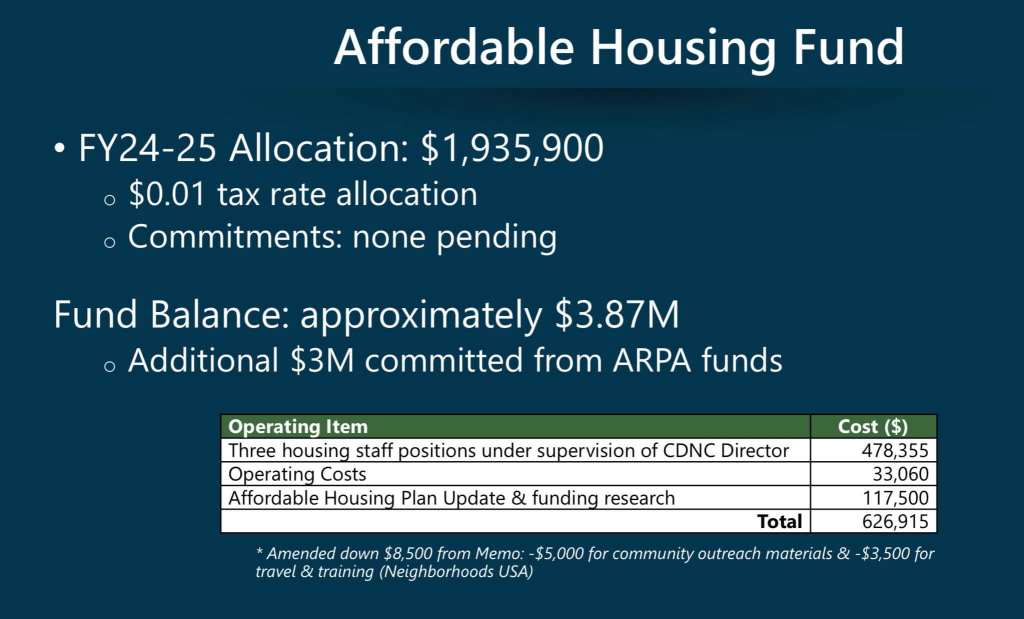
Discussion point: funding our Affordable Housing staff through our Affordable Housing Fund. This was a recommendation out of Finance Committee (myself and MPT Gray). We felt it was appropriate and even desirable to have a dedicated tax rate backing staff working on Affordable Housing, and was an appropriate use of those funds. CM Zegerman disagreed, and felt the AH funds should be reserved exclusively for projects. The recommendation to fund staff from the fund was adopted 4-1 (Zegerman dissenting).
Staffing changes this year: We’re hiring 41 new positions this year. The summary is below, but a highlight is our continued commitment to our multiyear staffing plan, including 12 new positions in APD (although we learned that 2 SRO positions will be likely be delayed into the following FY to keep with the school construction schedule)
We had a discussion about SRO’s, specifically their funding source. In summary, we are only reimbursed for roughly half of the salary and none of the equipment associated with staffing an SRO position at the middle school and high school level, and there is no reimbursement for Elementary School SROs. As a result, Apex (along with Holly Springs) are the only two municipalities self funding Elementary School SROs. CM Gantt objected to this arrangement, and pointed out each SRO we have could instead be a patrol officer (that we are struggling to increase). He expressed a desire to end the elementary school SRO program and convert those positions to patrol officers. His position was not seconded by anyone else on the Council. I expressed that the best way forward would be to keep them status quo while we work with partners at the county and state level for a more equitable funding arrangement.
Below I included a slide which showed some projects aligning with our strategic goals. There isn’t much discussion, but I felt like it was a good summary to include.
We had a discussion about Apex’s policy of waving application and other fees associated with a solar installation. It has been our policy, as the most solar friendly community in the state, to waive all of these fees since 2018 I believe. This year, due to challenges in the Electric Fund, staff proposed to add them back. I felt like the revenue lost here wasn’t yet significant enough to abandon this policy which aligns so well with our strategic goals of being an Environmental Leader. Others expressed a desire, given the challenges this year and in upcoming years to the Electric utility, that we should tighten up programs like this. That position carried, and the fees were adopted by a 3-2 vote (Mahaffey, Zegerman dissenting)
Finally, the electric rate itself. This year proposes a 14% increase in rates. The way the math works out, last year we had a base rate increase and a per kW/hr DECREASE. This year the proposal raises the kW/hr rate to approximately what it was last year before the decrease.
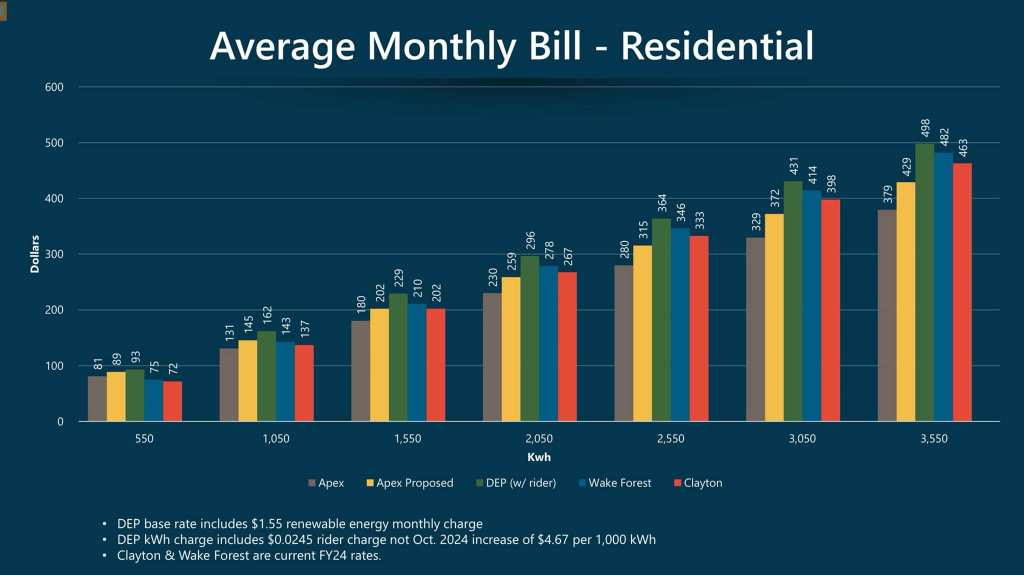
Even with this increase, we have the lowest electric costs in the region – and that’s compared to Duke and other municipalities rates LAST year. See the chart below. We have a really good deal, but we know that it will get tough in coming years as we re-negotiation with Duke. We’re aware that Duke has passed on significant costs in the form of rate increases to their customers, and it’s pretty clear they’ll do the same to us when our contract expires.
The reason for the increase this year include;
- “True up” costs, this is in the contract with Duke. If they lost money on us, they can bill us. A lot of this relates to how warm the winter was, the price of fuel, etc. We take on that risk with them.
- Infrastructure maintenance costs. Materials are getting significantly more expensive (transformers, etc) and have longer lead times
- Just general inflation, wages, etc
It’s our goal to keep rates as low as possible, and we are proud to still be the lowest rate (more so, once everyone else updates their FY25 rates too). But we see challenges here in the future.



 VISION OF THE PEAK